
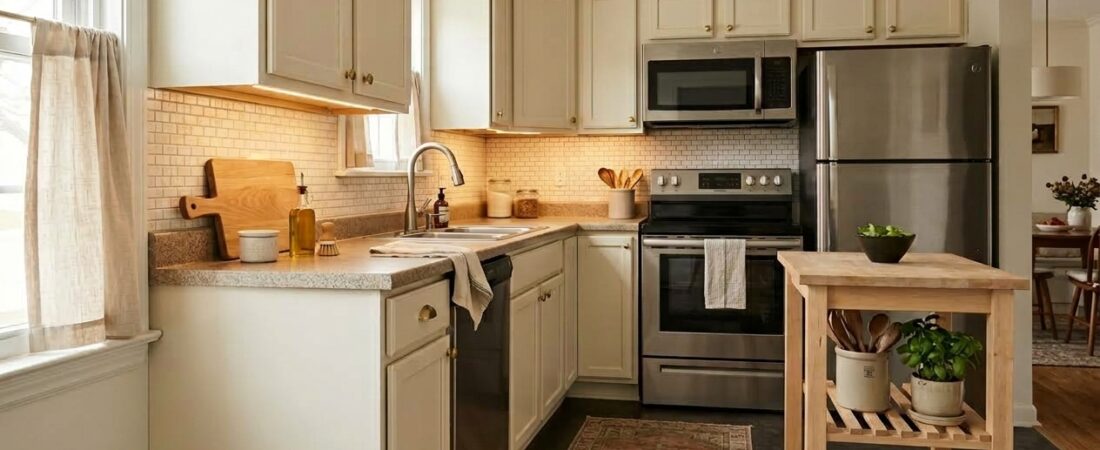
Renter-friendly kitchen upgrades can transform a perfectly functional rental kitchen that still makes you sigh every time you walk into it.
Maybe the cabinets feel dated. The overhead light makes everything look flat. The backsplash isn’t your style. Or maybe nothing is particularly wrong—the whole room just feels temporary and not quite like you.
The good news? You don’t have to change everything to make a rental kitchen feel beautiful.
In fact, the most convincing renter-friendly kitchen upgrades are often the ones that fix whatever is making the room feel unfinished: dated details, harsh lighting, an awkward space, visual clutter, or a lack of warmth.
The eight upgrades below were chosen for more than their before-and-after potential. We considered visual impact, renter commitment, effort, reversibility, versatility, and likely cost so you can decide what’s actually worth changing in your kitchen.
And no—you don’t need to do all eight.
Disclosure: This post may contain affiliate links in the future. If you purchase through one of those links, TheHomeCurate may earn a commission at no additional cost to you. Our recommendations are always based on what we believe is useful and relevant to our readers. Read our full Affiliate Disclosure for more information.
Not Sure Where to Start? Start With What Bothers You Most
Before buying anything, look at your kitchen and ask one question:
What is making this room feel wrong to me?
| If your kitchen feels… | Start here |
|---|---|
| Dated or builder-basic | Swap the cabinet hardware |
| Cold, dark, or harsh | Layer the lighting |
| Dominated by an unattractive backsplash | Consider a removable backsplash |
| Short on storage or workspace | Add the right freestanding piece |
| Plain or impersonal | Add a café curtain or runner |
| Visually cluttered | Use vertical storage, then edit the counters |
Sometimes one high-impact change does more for a room than five little decorating hacks.
That’s exactly where I’d start.
1. Swap the Cabinet Hardware
Best for: Dated or builder-basic cabinets
Visual impact: High
Effort: Low
Renter commitment: Low
Worth considering? ★★★★★
If your cabinets aren’t terrible but somehow make the entire kitchen feel dated, look at the hardware before blaming the cabinets themselves.
Changing basic knobs or pulls can make existing cabinetry feel much more intentional because hardware reads as part of the kitchen—not as decoration sitting on top of it.
For the lowest-commitment approach, look for replacement hardware that fits the existing holes rather than drilling new ones. Keep every original knob, pull, and screw together in a labeled bag so they can be reinstalled before you move.
The finish matters, too. Warm brass can soften a neutral kitchen, matte black can add definition, while simple nickel or chrome can work beautifully in a cleaner, more understated space.
The goal isn’t to choose the trendiest hardware.
It’s to choose something that makes the cabinets look like they were supposed to come that way.
Skip it if: Replacing the hardware would require drilling new holes, altering the cabinetry, or doing something your lease doesn’t permit.
2. Layer the Lighting Without Rewiring the Kitchen
Best for: Kitchens that feel cold, flat, or harsh
Visual impact: High—especially after dark
Effort: Low to medium
Renter commitment: Low to medium
Worth considering? ★★★★★
Sometimes the problem isn’t your kitchen.
It’s the light you’re seeing it in.
A single bright overhead fixture can make even a nicely styled room feel stark. Instead of treating electrical work as the solution, think about layering light around the lighting you already have.
Rechargeable or plug-in under-cabinet lights can brighten work surfaces, while a small cordless lamp on an appropriate counter or shelf can create a softer pool of light. Where your existing fixtures and manufacturer specifications allow it, choosing a warmer-feeling bulb can also change the atmosphere considerably.
You don’t need to turn the kitchen into a mood-lit restaurant.
You want more than one light source so the room feels warmer, more dimensional, and inviting.
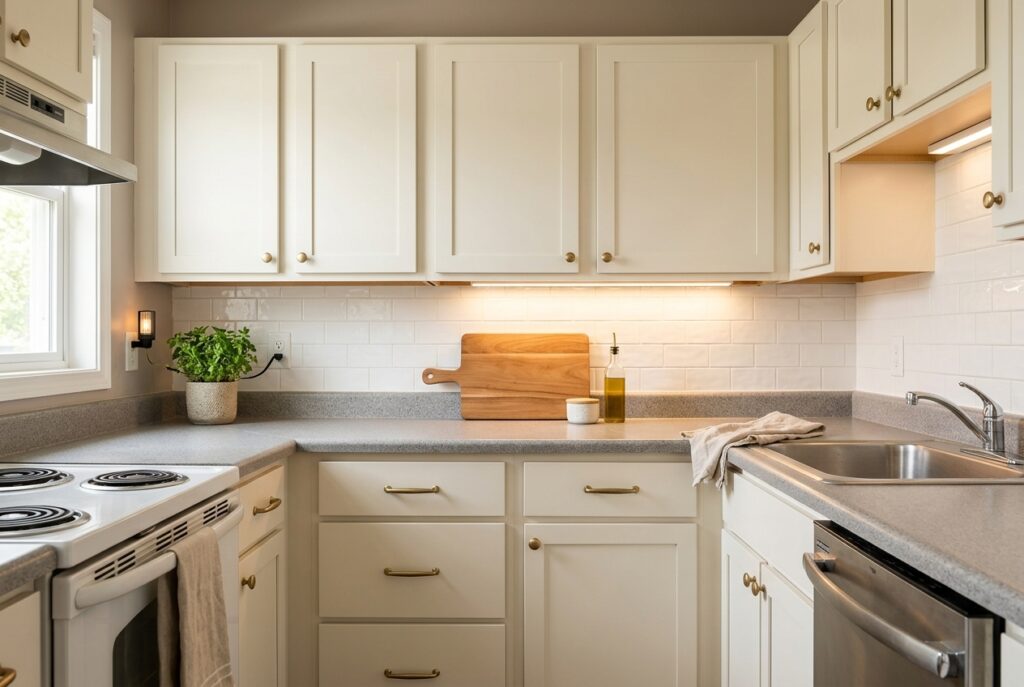
Rental kitchen with brass cabinet hardware and warm under-cabinet lighting
This is one of the most effective types of rental upgrades because you’re changing how the whole kitchen feels rather than trying to disguise every finish you don’t love.
Skip it if: A light would interfere with cooking, introduce unsafe cords near water or heat, or require an electrical modification. Always follow the fixture and product manufacturer’s placement and safety instructions.
3. Transform the Backsplash—But Only If the Surface Makes Sense
Best for: A dated backsplash that visually dominates the kitchen
Visual impact: Very high
Effort: Medium
Renter commitment: Medium
Worth considering? ★★★★☆
Few temporary kitchen upgrades can change such a large visual area as quickly as a well-chosen peel-and-stick backsplash.
But this is also where “renter-friendly” needs a reality check.
An adhesive product isn’t automatically appropriate for every painted wall, tile, laminate, or other surface. Heat, moisture, grease, texture, and the condition of the existing finish can all matter, as can the product’s installation and removal requirements.
So don’t begin with the pattern.
Begin with the surface.
Read the manufacturer’s instructions for the exact product you’re considering, check your lease where relevant, and test compatibility in an inconspicuous area when appropriate. Pay particular attention to manufacturer requirements around heat-producing appliances and cooking zones.
Once you’ve established that the product is suitable, then think about aesthetics.
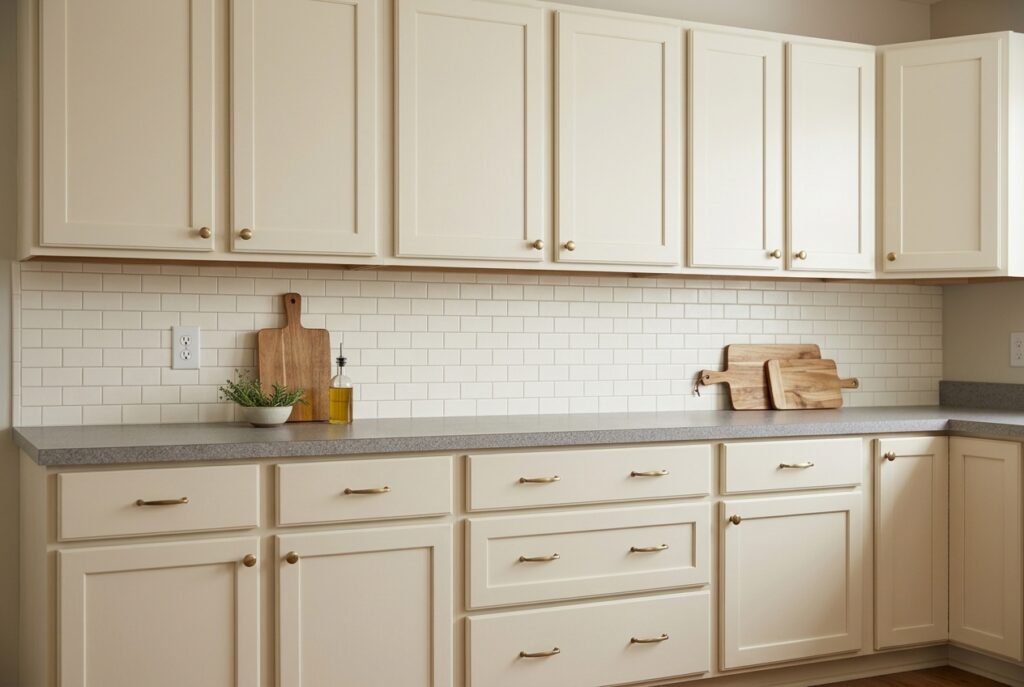
A backsplash usually looks more convincing when it complements the existing cabinets and counters rather than trying to overpower them. Simple tile-inspired patterns and restrained finishes can often feel more integrated than something chosen solely because it makes a dramatic before-and-after photo.
Skip it if: You’re uncertain about surface compatibility, removal, heat exposure, or your rental agreement.
A beautiful kitchen isn’t worth creating a move-out problem.
4. Add a Freestanding Piece That Looks Like It Belongs There
Best for: Missing storage, inadequate workspace, or an awkward open area
Visual impact: Very high
Effort: Low to medium
Renter commitment: Low
Worth considering? ★★★★★—when the kitchen has room for it
This is where a rental kitchen can start feeling intentionally designed rather than temporarily furnished.
If you need more prep space, a freestanding kitchen island or butcher-block cart can create a useful work zone without becoming part of the permanent cabinetry.
If storage is the real problem, however, don’t buy an island simply because kitchen makeovers tell you to.
A narrow pantry cabinet, freestanding cupboard, or other storage piece may solve the problem much better.
The secret is choosing something that relates visually to the kitchen around it.
Look at the wood tones, cabinet color, hardware, and proportions already in the room. A piece that echoes one or two of those elements can feel intentional even though it isn’t actually built in.
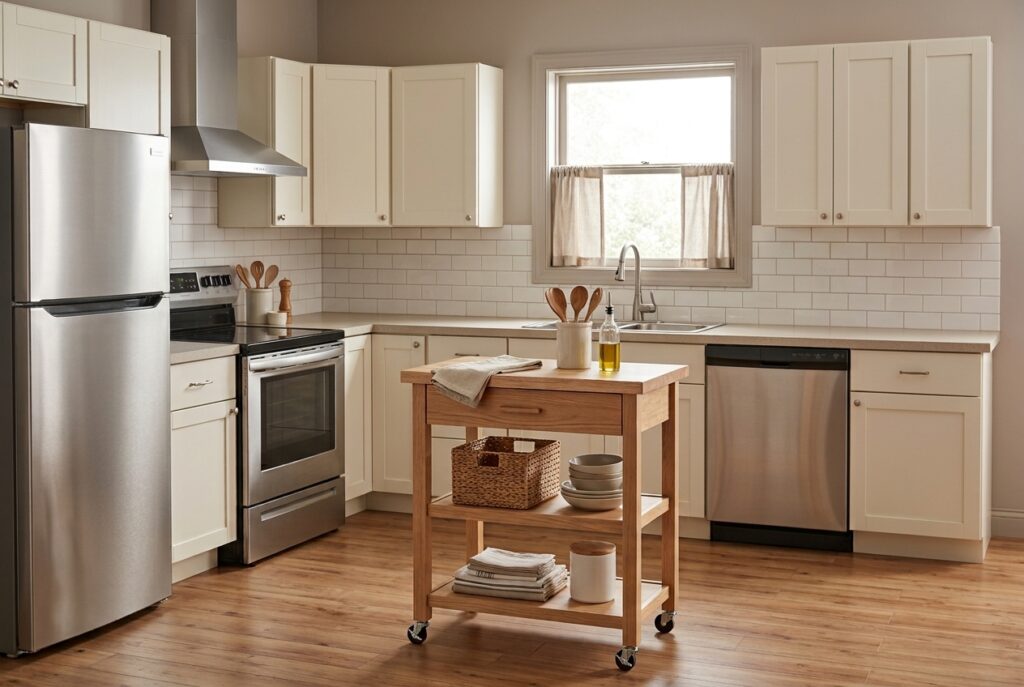
And measure carefully.
You still need comfortable pathways and access to cabinets, appliances, and doors. A gorgeous island that makes you squeeze sideways through your kitchen is not an upgrade.
Skip it if: Your kitchen doesn’t have enough clearance. In a very small kitchen, preserving open floor space may make the room feel better than adding another piece of furniture.
5. Soften the Room With a Café Curtain
Best for: Kitchens that feel plain, hard, or impersonal
Visual impact: Medium
Effort: Low
Renter commitment: Low
Worth considering? ★★★★☆
Kitchens contain a lot of hard surfaces: cabinetry, counters, appliances, flooring, and tile.
A little fabric can change the mood.
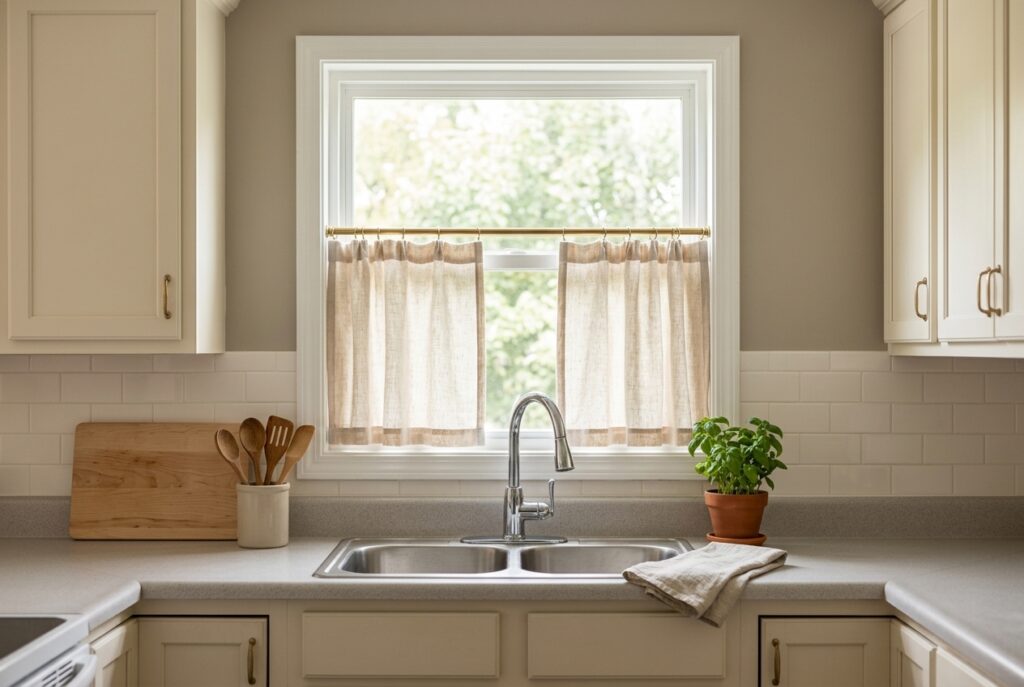
A café curtain adds softness and personality without covering the entire window, and in the right space it can make an ordinary rental kitchen feel unexpectedly charming.
For a lower-commitment installation, a properly sized tension rod or another suitable no-drill solution may work depending on your window.
Keep the fabric proportionate to the room. Linen-look neutrals, small-scale patterns, or soft checks can add interest without making a small kitchen feel busy.
This isn’t the upgrade I’d choose first if you’re dealing with terrible lighting or badly dated cabinets.
But once the bigger visual problems are handled?
It’s the kind of detail that makes a kitchen start feeling like your home instead of your rental.
Skip it if: The window sits where fabric could create an inappropriate safety issue, or if the installation method isn’t suitable for the window structure.
6. Turn Empty Vertical Space Into Intentional Storage
Best for: Kitchens where clutter is stealing the attention
Visual impact: Medium
Effort: Low to medium
Renter commitment: Low to medium
Worth considering? ★★★★☆
More storage doesn’t automatically create a better-looking kitchen.
Sometimes it creates more places to display clutter.
Instead, use vertical space selectively.
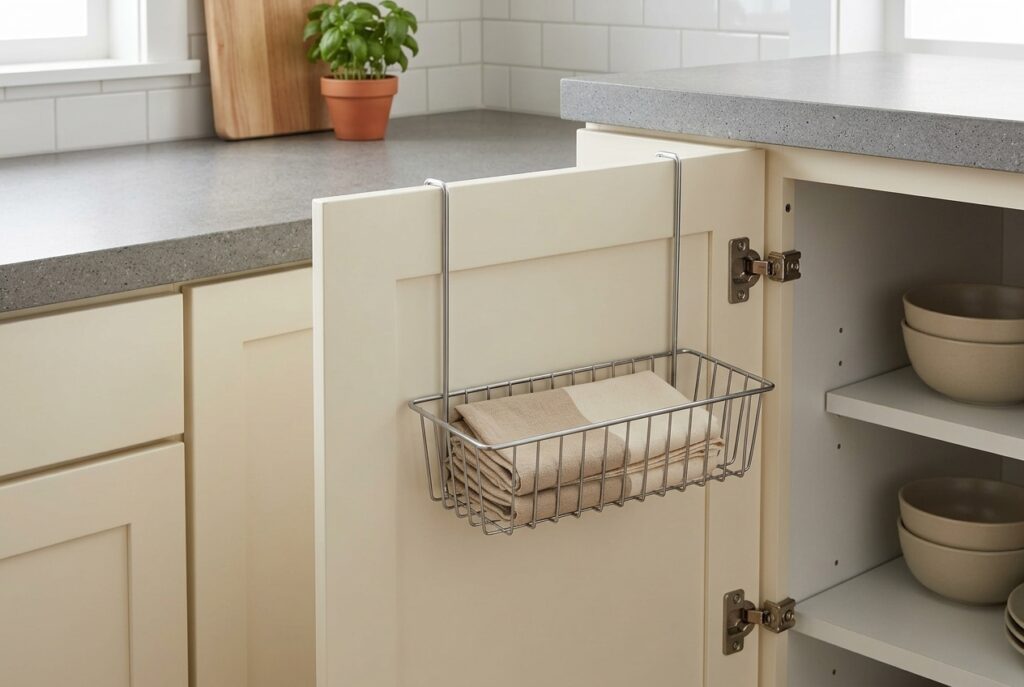
Depending on the kitchen, that might mean an over-door organizer hidden inside a cabinet, magnetic storage on an appropriate metal surface, a tension-based solution, or another no-drill organizer designed for the surface and weight it needs to hold.
The goal is not:
How much can I hang on this wall?
It’s:
What can I remove from sight so the kitchen feels calmer?
Prioritize the things currently crowding your counters—provided the storage solution is appropriate and securely installed.
And be skeptical of universal “damage-free” claims. Adhesives, mounting systems, surfaces, and weight limits differ. Follow the product instructions and don’t overload a solution just because Pinterest made it look effortless.
Skip it if: The organizer creates more visual noise than the objects you’re trying to store, or if you can’t install it appropriately for the surface and intended load.
7. Edit Your Countertops Before You Decorate Them
Best for: A kitchen that feels messy even when it’s technically clean
Visual impact: Medium to high
Effort: Low
Renter commitment: None
Worth considering? ★★★★★
Before buying another kitchen accessory, take things away.
Countertops often become permanent parking spots for appliances, bottles, mail, utensils, food packages, and all the little things we use throughout the week.
Individually, none of them is a problem.
Together, they can make the entire kitchen feel unfinished.
Start by keeping out what you genuinely use often. Group related everyday items where it makes sense, and give everything else a home.
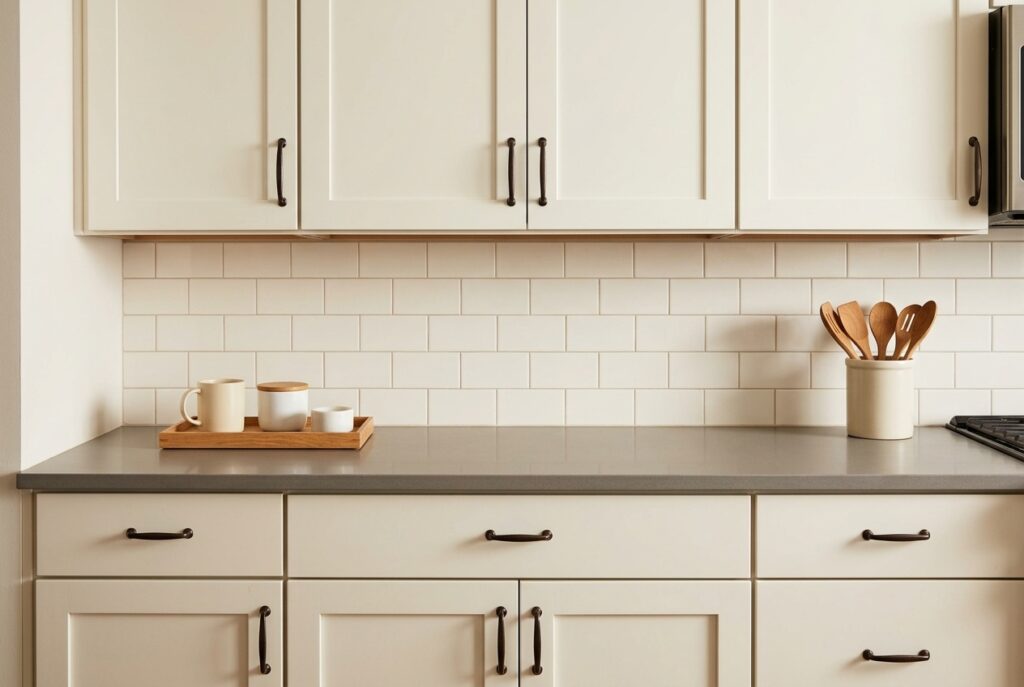
If you want a styled moment, keep it functional: perhaps a small tray containing the items you reach for every morning, a simple crock for utensils, or one decorative object that earns the space it occupies.
You don’t need matching containers for everything.
You need less visual competition.
This is also why it makes sense to make this change after solving storage. It’s much easier to create a beautiful counter when everything doesn’t have to live on it.
Skip it if: “Styling” means buying a collection of decorative objects that will simply replace the clutter you just removed.
Sometimes the best renter-friendly upgrade costs nothing.
8. Finish the Kitchen With a Washable Runner
Best for: Kitchens that still feel cold, plain, or unfinished
Visual impact: High
Effort: Very low
Renter commitment: Very low
Worth considering? ★★★★★
After the practical problems are solved, this is where you get to have some fun.
A kitchen runner can bring in something cabinets and countertops often can’t: softness, pattern, color, and personality.
And because it isn’t attached to the rental, it’s one of the easiest ways to make the room feel more like yours.
A warm neutral runner can soften a high-contrast kitchen. A restrained pattern can wake up plain cabinetry. A deeper tone can ground a pale space that otherwise feels washed out.
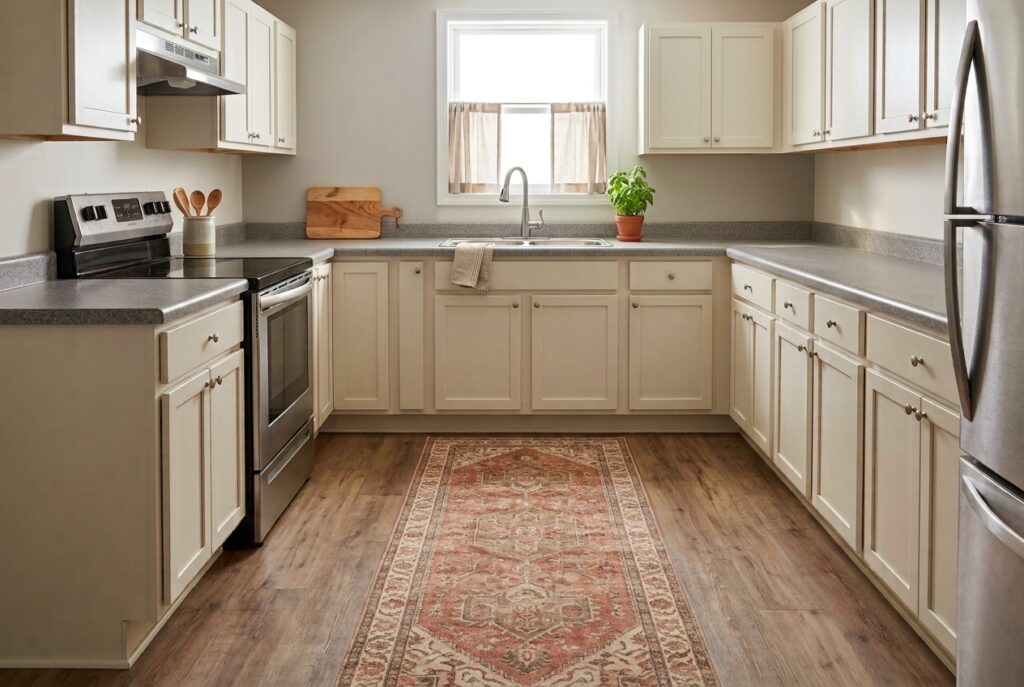
Just don’t choose the rug from a styled product photo alone.
Measure the actual floor area, make sure doors and appliances can operate properly, and choose a construction appropriate for a kitchen’s real-life spills and foot traffic. Follow the rug manufacturer’s care and safety guidance, including any recommendations regarding backing or rug pads.
The right runner shouldn’t feel like you’re covering up the rental.
It should feel like the final layer that pulls everything together.
Which Renter-Friendly Kitchen Upgrades Are Actually Worth Doing First?
The one that solves the problem you notice every day.
When dated cabinets are the problem, start with hardware.
For a kitchen that feels gloomy every evening, work on lighting.
When one unattractive surface dominates everything else, consider whether an appropriate removable backsplash makes sense.
And if clutter is the problem, don’t buy décor—solve the storage problem first.
And if the kitchen already functions well but simply doesn’t feel like you, textiles such as a café curtain or washable runner may deliver more happiness than a complicated DIY project ever could.
That’s the difference between decorating around a problem and actually solving it.
You don’t need eight upgrades.
You need the right one—or perhaps two or three—that change what you see and how you feel when you walk into the room.
What to Skip in a Rental Kitchen
Not every renter hack is worth trying.
Be cautious with changes that require drilling into tile or stone, permanently altering cabinetry, modifying electrical fixtures, painting surfaces without permission, or installing something that may be difficult to remove cleanly.
Even products marketed as “removable,” “peel-and-stick,” or “damage-free” aren’t automatically appropriate for every surface.
Check the manufacturer’s instructions, test adhesives in an inconspicuous area when appropriate, and review your lease or ask your landlord before making a change you’re unsure about.
The best renter-friendly kitchen upgrades should make your space work and feel better without creating a bigger problem when it’s time to move out.
A Beautiful Rental Kitchen Doesn’t Have to Pretend It’s Permanent
The best rental kitchen makeover isn’t necessarily the one where nobody can tell you’re renting.
It’s the one where you stop noticing everything you can’t change.
Good hardware can make existing cabinets feel intentional. Better lighting can make the room warmer. A carefully chosen freestanding piece can solve the storage your rental never gave you. And textiles can add the softness and personality the original kitchen was missing.
Make the changes that solve your kitchen’s biggest problems, keep reversibility in mind, and don’t assume every popular renter hack deserves a place in your home.
Because a rental may be temporary.
Feeling at home in it doesn’t have to be.
If you’d like more ideas before deciding which changes are right for your space, explore our Renter-Friendly Kitchen Ideas: 9 Easy Upgrades for Renters for more simple ways to refresh a rental kitchen.
And if your kitchen is part of a compact apartment, our Small Apartment Living Room Ideas That Feel Bigger guide has more ideas for making limited space feel intentional, comfortable, and beautifully put together.
Where We Find Products
TheHomeCurate researches home products and decorating ideas across a range of retailers and sources to help readers discover options that fit different spaces, styles, and budgets. We prioritize usefulness, relevance, and reader fit when deciding what to feature.
Some articles may contain affiliate links when TheHomeCurate has an active relationship with a retailer or affiliate program. If affiliate links are used, they will be disclosed, and TheHomeCurate may earn a commission from qualifying purchases at no additional cost to you. See our Affiliate Disclosure for more information.